
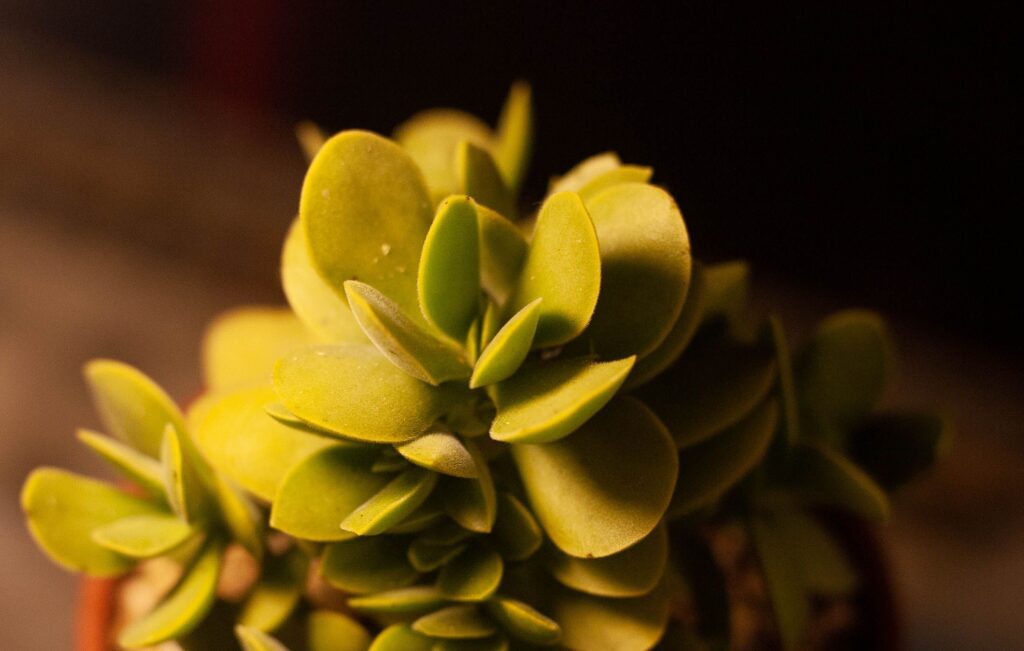
The jade plant is the “lucky plant” you see on office desks, shop counters and balcony railings all over Delhi NCR. It is also one of the easiest plants to harm with too much love, because most people water it far too often.
The good news is that once you understand how a jade plant (Crassula ovata) works, it can live for decades. This guide covers jade plant care in Indian weather, the real benefits (and a few myths), the best Vastu direction, current prices, pet safety and how to grow new plants from a single leaf.
Jade plant at a glance
- Botanical name: Crassula ovata
- Light: at least 4–6 hours of bright light
- Water: only when the top inch of soil is dry
- Best temperature: 18–24 °C
- Pets: toxic to dogs and cats
- Price in India: about ₹69 for a small sapling to about ₹750 for a potted pair (November 2026)
- Lifespan: decades
What Is a Jade Plant?
A jade plant (Crassula ovata) is a succulent with thick, glossy, oval leaves and woody stems that make it look like a tiny tree. It comes from South Africa and Mozambique, and it stores water in its leaves. That is why it copes with dry spells so well.
It grows slowly. Indoors it usually reaches about 3 feet (90 cm) or more, while in the wild it can grow up to 2.5 metres, according to Wikipedia’s page on Crassula ovata.
Jade plant facts in one table
| Detail | Jade plant |
|---|---|
| Botanical name | Crassula ovata (older name: Crassula argentea) |
| Family | Crassulaceae |
| Home | South Africa and Mozambique |
| Height indoors | About 3 feet (90 cm) or more |
| Growth speed | Slow |
| Flowers | White or pink, star-shaped, usually in winter |
| Good for | Beginners, desks, balconies and gifting |
Other names for the jade plant
You will hear many names for the same plant: lucky plant, money plant, friendship plant, silver dollar plant and jade tree. In plant shops you may also see its older name, Crassula argentea.
“Friendship plant” has a good reason behind it. A jade plant is so easy to grow from cuttings that people share it the way they share a family recipe.
Jade Plant vs Money Plant vs Money Tree: Which Is Which?
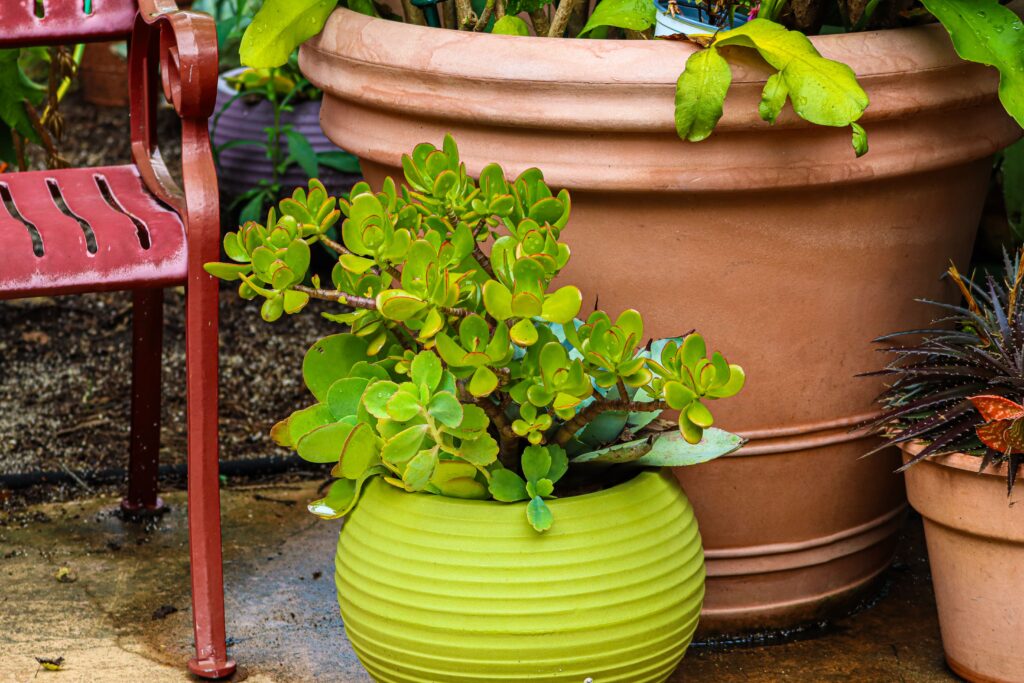
They are different plants. The confusion happens because all of them are called “lucky” in Indian homes.
In India, “money plant” usually means the trailing pothos with heart-shaped leaves (Epipremnum aureum). A jade plant is the thick-leaved succulent. “Money tree” often means Pachira aquatica, a plant with a braided trunk, though Wikipedia notes that jade sometimes gets that nickname too.
| Jade plant | Money plant (pothos) | Money tree | |
|---|---|---|---|
| Botanical name | Crassula ovata | Epipremnum aureum | Pachira aquatica |
| Leaves | Thick, glossy and oval | Thin and heart-shaped | Leaf clusters on a trunk |
| Growth | Slow, woody and tree-like | A vine that trails or climbs | A small tree with a braided trunk |
Here is an easy test. A friend hands you a “money plant” cutting in a glass of water, and that is pothos. A jade leaf never goes into water; it goes on soil.
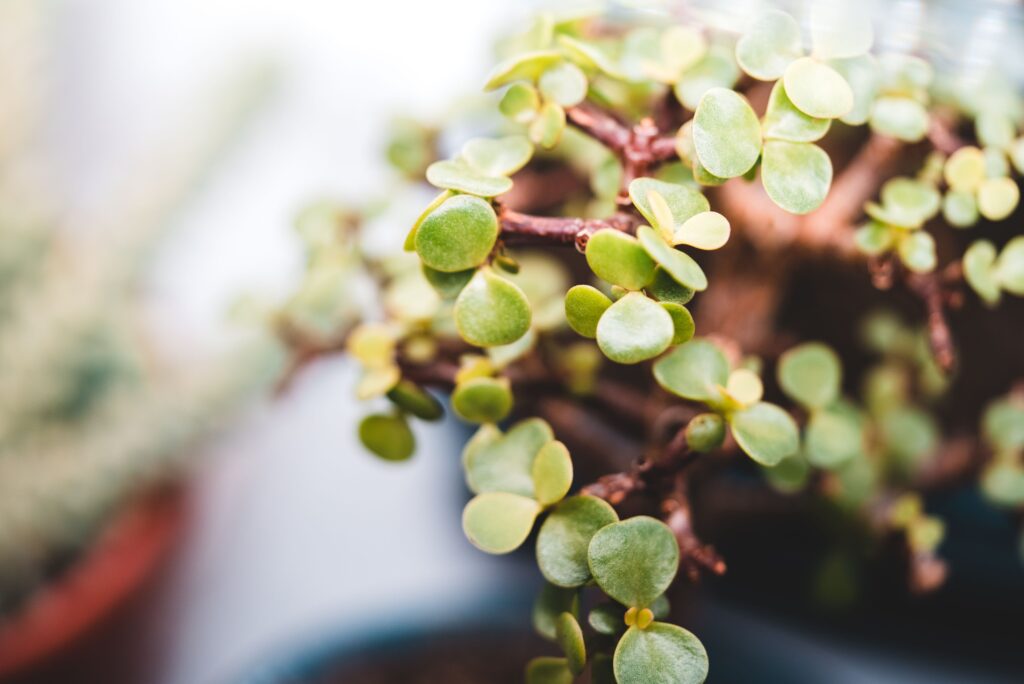
One more mix-up: “dwarf jade” usually means Portulacaria afra, also called elephant bush. It is not a small Crassula ovata.
Jade Plant in Hindi, Telugu, Tamil and Other Indian Languages
Many readers search for the jade plant in their own language, so here is a quick guide. Most people simply type the English name in their own script.
Jade plant in Hindi (जेड प्लांट)
In Hindi, most people say जेड प्लांट or क्रासुला. Many homes also call it लकी प्लांट.
जेड प्लांट (क्रासुला ओवाटा) एक रसीला पौधा है। इसकी पत्तियां मोटी और चमकदार होती हैं और इसे लकी प्लांट भी कहा जाता है। इसे अच्छी रोशनी में रखें और पानी तभी दें जब मिट्टी ऊपर से सूख जाए।
Jade plant in Telugu, Tamil, Kannada, Malayalam and Marathi
| Language | How people usually write it |
|---|---|
| Telugu | జేడ్ ప్లాంట్ |
| Tamil | ஜேட் செடி |
| Kannada | ಜೇಡ್ ಪ್ಲಾಂಟ್ |
| Malayalam | ജേഡ് ചെടി |
| Marathi | जेड प्लांट |
The name changes, but the care does not. Bright light and very little water work in every language.
Types of Jade Plant (With Photos)
Crassula ovata comes in many varieties. If you scroll through jade plant photos online, you will see tube-shaped leaves, creamy variegation and bright red edges. Every plant in the table below is still a jade plant.
Popular varieties
| Variety | What it looks like | Mature size |
|---|---|---|
| ‘Hummel’s Sunset’ | Green leaves with yellow, orange and red edges in bright light | 2–3 ft (60–90 cm) |
| ‘Gollum’ (ET’s Fingers) | Tube-shaped leaves with flared, red-tipped ends | About 3 ft (90 cm) |
| ‘Hobbit’ | Tubular leaves with curled tips | About 4 ft (1.2 m) |
| ‘Tricolor’ | Green leaves streaked with cream and pink | 2–4 ft (60–120 cm) |
| ‘Variegata’ | Green leaves with cream patterns | Up to 6 ft (1.8 m) |
| ‘Crosby’s Compact’ | Small, reddish leaves on short branches | About 3 ft (90 cm) |
‘Hummel’s Sunset’ has won the Royal Horticultural Society’s Award of Garden Merit, which is a nice sign of quality.
Look-alikes that are not true jade
Some shops sell other plants as “jade.” Silver jade (Crassula arborescens) has silvery-blue leaves and is a different species. Dwarf jade (Portulacaria afra) is not a Crassula at all.
Before you pay, check the label. A true jade plant carries the name Crassula ovata.
Jade Plant Benefits: What Is Real and What Is Myth
Most lists of jade plant benefits promise a lot. Here is what holds up and what does not.
Benefits you can count on
- It forgives mistakes. The leaves store water, so a missed watering rarely hurts it.
- It lives for decades. Many families pass one plant down through the generations.
- One leaf makes a new plant. That makes it a lovely, free gift for friends and neighbours.
- It looks tidy. The tree-like shape suits a desk, a shelf or a small balcony.
- It handles dry indoor air. Warm, dry rooms suit it fine.
Claims to treat with care
| Claim | What the evidence says | What to believe |
|---|---|---|
| It cleans the air | You would need an impractical number of plants to clean a room’s air | Enjoy the look, and open a window for fresh air |
| It gives out oxygen all night | Jade takes in carbon dioxide at night but makes most of its oxygen by day | Do not count on it for your bedroom |
| It brings wealth | This is a cultural tradition with no evidence behind it | Keep it as a belief, not a plan |
| It treats warts or upset stomachs | Some regions use it as folk medicine, but there is no proof, and the sap can irritate skin | Never eat it |
Jade plant benefits in Hindi (जेड प्लांट के फायदे)
- देखभाल में आसान: कम पानी में भी जेड प्लांट आराम से चल जाता है।
- लंबी उम्र: सही देखभाल मिले तो यह कई दशकों तक जीवित रहता है।
- आसानी से बढ़ता है: एक पत्ती या डंठल से नया पौधा तैयार हो जाता है।
- घर की सजावट: मोटी, चमकदार पत्तियां बालकनी और डेस्क को ताज़ा लुक देती हैं।
- मान्यता: वास्तु और फेंग शुई में इसे समृद्धि का प्रतीक माना जाता है, पर यह एक मान्यता है, वैज्ञानिक प्रमाण नहीं।
Jade Plant Vastu: Best Direction and Where to Keep It
The southeast is the direction most Vastu pages suggest for a jade plant, and east comes second. North is debated. Almost every source says to keep it out of bathrooms and bedrooms.
Please remember that Vastu and Feng Shui are traditions. There is no evidence that a plant changes your finances. If the tradition matters to you, here is how to follow it without hurting the plant.
Which direction is best?
- Southeast: the “wealth corner” in Vastu, and the most suggested spot.
- East: linked with health, peace and growth, and a good choice for a desk or study table.
- North: sources disagree. NoBroker calls it debatable, while YF Decor says to avoid it.
Best spots at home and office
The usual advice is to place it near the main entrance, in a bright corner of the living room, on a work desk or on a balcony. Picture a desk beside an east-facing window in a Gurugram office. The plant gets gentle morning sun, and you get your “wealth corner” too.
Where not to keep it
- Bathrooms and toilets, which are damp and dark.
- Dark corners with little light.
- The kitchen, near heat.
- The bedroom, where sources disagree and the plant’s energy is said to disturb sleep.
Pick a spot the plant likes too
A jade plant needs 4–6 hours of bright light, so a lovely Vastu spot in a dark corner will not work. An east window gives soft morning sun. South and west windows are brighter, but in an NCR summer the afternoon heat can scorch the leaves.
Jade Plant Care: The Simple Routine That Works
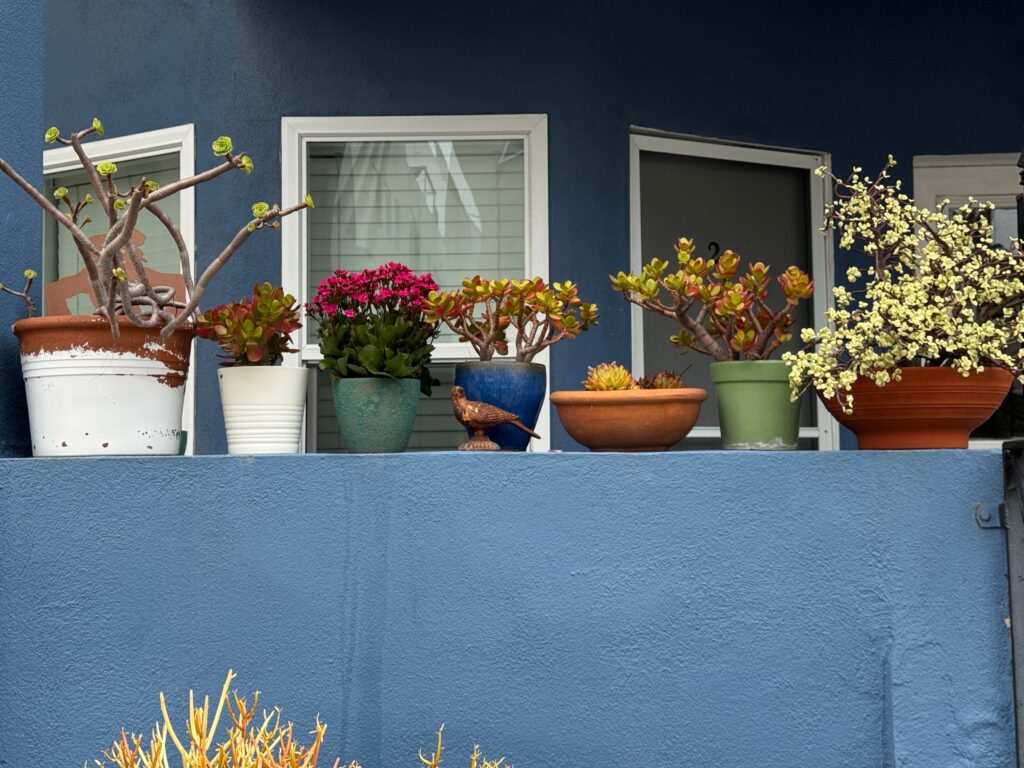
Good jade plant care comes down to five things: bright light, careful watering, gritty soil, a pot with holes and a little food in the growing season. Get those right and the plant mostly looks after itself.
Light: how much sunlight does a jade plant need?
A jade plant needs at least 4–6 hours of bright light a day. Indoors, put it next to the brightest window you have. A plant in a dim room turns tall, thin and floppy as it stretches toward the light.
In India, the sun can be harsh. A plant moved straight from a shaded shop to a south-facing balcony in May can get sunburnt, with brown or white patches on the leaves. Move it into stronger light over a week or two.
Indoor jade plant or outdoor jade plant?
Both work. An indoor jade plant is happy near a bright window. An outdoor jade plant does well on a balcony or terrace that gets morning sun and some shade in the afternoon.
During heavy monsoon rain, move the pot under cover. Soggy soil is the fastest way to lose a jade plant.
Watering: the most important rule
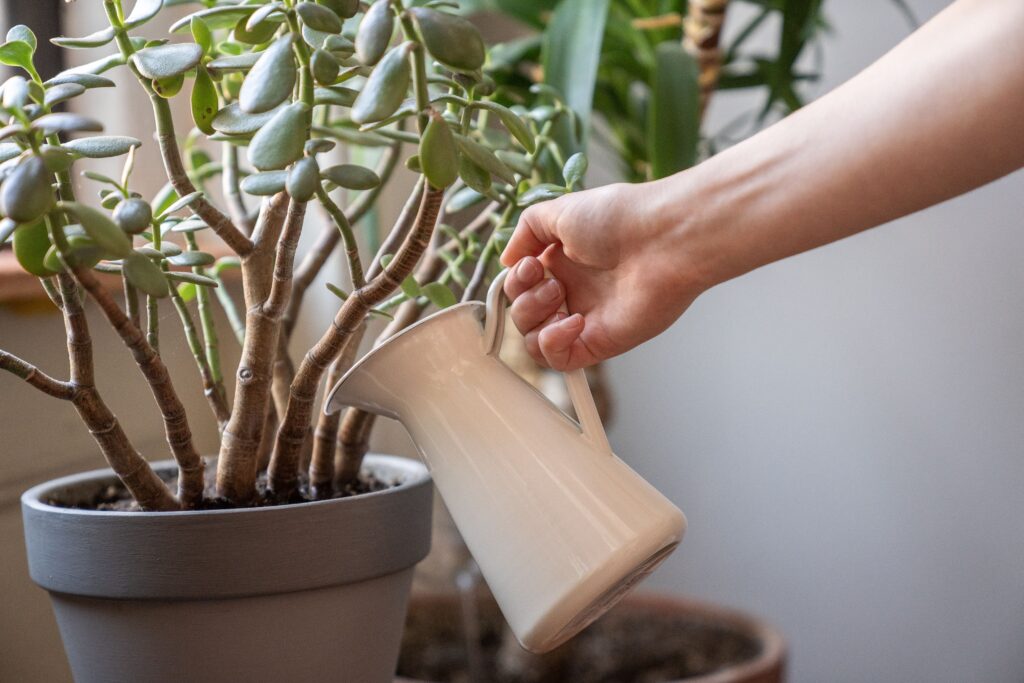
Water the jade plant only when the top inch of soil is dry. Push a finger into the soil to check. Then water deeply until the extra drains out of the bottom, and empty the saucer.
A simple seasonal guide for most Indian homes:
| Season | What to do |
|---|---|
| Summer (Apr–Jun) | Check every week. Water when the top inch is dry, usually every 7–10 days |
| Monsoon (Jul–Sep) | Water less, because humid air keeps soil wet for longer. Always check first |
| Autumn (Oct–Nov) | Water as soil dries. This is the best growing weather |
| Winter (Dec–Feb) | Water sparingly, maybe once every 2–3 weeks |
These are starting points, not a calendar. Pot size, soil and light change everything, so trust your finger more than the date.
Here is a common story. Someone waters a jade plant every Sunday “so it doesn’t get thirsty.” Three months later the leaves are soft and yellow. The plant was never thirsty; the roots were sitting in wet soil.
Best soil for a jade plant
Use a fast-draining mix. A ready cactus or succulent mix works well. For a homemade version, mix about 2 parts regular potting soil with 1 part coarse sand and 1 part perlite or fine gravel.
Skip heavy garden soil on its own. It holds water, and the roots stay wet.
The right pot for a jade plant
Choose a pot with drainage holes. Terracotta is a great pick because the clay lets the soil dry faster. Jade plants get top-heavy as they grow, so a wide, sturdy jade plant in a pot is better than a tall, narrow one.
Pick a pot only 1–2 inches wider than the root ball. A pot that is too big keeps extra soil wet.
Temperature and humidity
Jade plants like normal room temperatures of around 18–24 °C. They tolerate Indian summers well if they are out of the harshest afternoon sun. Protect them from frost, which is rare in most of India but can be an issue in hill areas and on cold north Indian winter nights.
They do not need extra humidity. Dry indoor air suits them fine.
Fertiliser
Feed lightly in the growing season. Use a balanced fertiliser, or a cactus feed, at half strength, once a month. Stop feeding in winter.
More food does not mean faster growth. Too much fertiliser can burn the roots and make the plant weak.
Pruning and shaping
Prune in spring or early summer. Cut just above a pair of leaves with clean, sharp scissors, and new branches will grow from that spot. This is how you turn a lanky plant into a full, bushy one.
Do not throw the cuttings away. Each one can become a new plant (see the propagation section).
Repotting
Repot every 2–3 years, or when roots peek out of the drainage holes. Do it in spring. Let the soil dry for a few days first, shake off the old soil and move the plant to a pot just one size up.
Wait about a week before watering again so any damaged roots can heal.
Quick jade plant care checklist
- Bright light for 4–6 hours a day.
- Water only when the top inch of soil is dry.
- Use gritty, fast-draining soil.
- Use a pot with drainage holes.
- Feed at half strength once a month in the growing season.
- Prune in spring and repot every 2–3 years.
Jade Plant Flower: Will Your Plant Bloom?
Yes, a jade plant flower is possible, but it is not guaranteed. Mature plants can produce clusters of small white or pink star-shaped flowers, usually in winter.
Indoors, blooms are less common. The usual trigger is a cool, bright autumn: slightly cooler nights, less water and plenty of light.
How to encourage flowers
- Give it bright light all year.
- In autumn, water less and keep nights a little cooler if you can.
- Keep the plant mature and healthy. Young plants rarely flower.
- Be patient. Some plants take several years.
If yours does not flower, do not worry. A healthy, glossy plant is already a success.
Jade Plant Bonsai: Turn It Into a Mini Tree
A jade plant bonsai is a good first bonsai. The woody trunk and thick branches already look like a small tree, and the plant forgives rough pruning.
Start with a plant that has a sturdy stem. Prune the branches back to shape a canopy, and use a shallow pot once the plant is established. Water sparingly, because a shallow pot dries differently from a deep one.
Go slowly. Remove a little at a time and let new growth appear before you cut again.
Jade Plant Propagation: How to Grow a New Plant from One Leaf or Stem
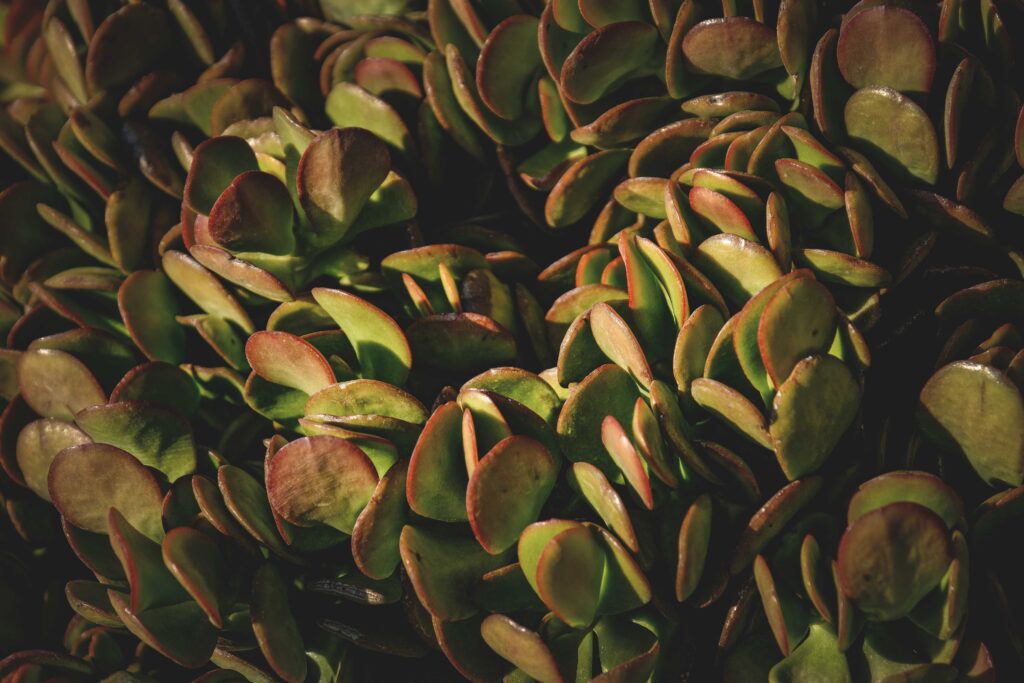
Jade plant propagation is easy, and it is why this plant is shared so widely. You can use a single leaf or a stem cutting.
Propagate from a leaf
- Gently twist a healthy leaf off the stem, so the whole leaf comes away cleanly.
- Leave it in a dry, shady spot for 2–3 days so the cut end forms a callus.
- Lay the leaf on top of dry, gritty soil. Do not bury it.
- Keep it in bright, indirect light and mist the soil lightly now and then.
- In a few weeks, tiny roots and a baby plant will appear.
Leaf propagation is slow. Be patient, because a baby plant can take a month or more to show up.
Propagate from a stem cutting
- Cut a stem piece about 3–4 inches long, just below a leaf pair.
- Remove the lowest leaves and let the cutting callus for a few days.
- Plant it in a small pot of cactus mix.
- Wait a week, then water lightly.
- Once it resists a gentle tug, roots have formed.
Stem cuttings are usually faster than leaves. Never put a jade cutting in a glass of water, because it tends to rot.
Common Jade Plant Problems and How to Fix Them
Most jade plant problems come from water or light. Use this table to find the cause quickly.
| What you see | Likely cause | What to do |
|---|---|---|
| Jade plant leaves turning yellow | Overwatering or poor drainage | Let the soil dry fully, check the pot holes and water less |
| Jade plant leaves falling off | Overwatering, a sudden cold or heat shock, or a big change of place | Check the soil, keep the plant in steady conditions |
| Jade plant leaves wrinkled or shrivelled | Underwatering, or damaged roots | Water deeply, then check the roots if wrinkles continue |
| Jade plant leaves turning red | Strong sun or mild stress | Often harmless, and many varieties get red edges in bright light |
| Soft, mushy stem | Root rot | Cut off the rotten parts and replant healthy cuttings in dry soil |
| Tall, thin, leggy growth | Not enough light | Move to a brighter spot and prune |
| White cottony spots | Mealybugs | Dab with cotton soaked in rubbing alcohol |
Why are my jade plant leaves turning red?
Red edges usually mean the plant is getting plenty of light. Varieties like ‘Hummel’s Sunset’ are even known for it. It is only a worry if the leaves also look scorched or dry.
Why are my jade plant leaves falling off?
The top reason is overwatering. A plant that gets watered too often drops soft, swollen leaves. Dry soil can also cause leaf drop, but then the leaves look wrinkled first.
Why are my jade plant leaves wrinkled?
Thin, wrinkled leaves mean the plant has used up its water store. Give it a good soak. If the leaves stay wrinkled even with moist soil, the roots may be damaged.
Is a Jade Plant Poisonous to Cats and Dogs?
Yes. According to the ASPCA, the jade plant is toxic to dogs and cats. Signs can include vomiting, low energy and poor coordination.
Keep the plant on a high shelf or in a room your pet cannot reach. If your pet chews it, call your vet or an animal poison helpline straight away.
It can also irritate skin, so wash your hands after pruning. Keep small children from putting leaves in their mouths.
Jade Plant Price in India and Where to Buy Online
A jade plant price in India depends on size, age and pot. In November 2026, small saplings started at about ₹69 online, while a potted pair was listed at about ₹750. Larger, older or designer-pot plants cost more.
| What you buy | Typical price (November 2026) |
|---|---|
| Small jade plant sapling | From about ₹69 |
| Jade plant in a decorative pot | Mid-range, depends on pot and size |
| Potted pair or gift set | Up to about ₹750 |
| Mature plant or bonsai-style plant | Higher, depends on age and shape |
Prices change often, so check the current listing before you order.
How to buy a jade plant online without regrets
If you want to buy a jade plant online, look for these signs of a healthy plant:
- Firm, plump, glossy leaves with no soft spots.
- A sturdy stem with no black or mushy patches.
- No white cottony bugs near the leaf joints.
- Clear photos of the actual plant, and a seller that explains how it is packed.
The label should say Crassula ovata. When the plant arrives, unpack it right away, keep it in bright indirect light and wait a few days before watering or repotting. It has had a long trip.
Jade plant in a pot for gifts
A jade plant in a pot is a popular gift for housewarmings, new offices and festivals. It is long-lasting, easy and meaningful. Add a short care card so the new owner does not overwater it.
Jade Plant FAQs
Is a jade plant good luck?
In Feng Shui and Vastu traditions, yes, it is seen as a symbol of prosperity. There is no scientific proof that a plant brings money, but many people enjoy keeping it for what it stands for.
Can a jade plant live indoors?
Yes. It does well indoors if it gets 4–6 hours of bright light near a window. Without enough light, it turns leggy and weak.
How often should I water a jade plant?
Only when the top inch of soil is dry. In most Indian homes that is every 1–2 weeks in summer and much less in winter and monsoon. Check the soil first, every time.
Why are my jade plant leaves turning yellow or falling off?
The most common cause is overwatering. Let the soil dry out, make sure the pot drains, and water less often.
Is a jade plant poisonous to cats and dogs?
Yes. The ASPCA lists it as toxic to both. Keep it out of reach and call your vet if your pet chews it.
Which direction is best for a jade plant as per Vastu?
Southeast is the most suggested direction, and east comes second. Avoid bathrooms and bedrooms. Make sure the spot also has enough light, or the plant will suffer.
Does a jade plant flower?
Yes, mature plants can produce small white or pink star-shaped flowers, usually in winter. Cool, bright autumn weather and less water help trigger them.
How do I grow a jade plant from a leaf?
Twist off a healthy leaf, let it dry for 2–3 days, then lay it on dry, gritty soil in bright indirect light. Roots and a baby plant usually appear in a few weeks.
How fast does a jade plant grow?
Slowly. Expect a few inches a year in good light. That slow pace is why older plants feel so special.
Is a jade plant the same as a money plant?
No. In India, a money plant is usually pothos, a trailing vine with thin heart-shaped leaves. A jade plant is a succulent with thick, oval leaves.
Need Help Growing Your Jade Plant?
If you would like a hand with your balcony, terrace or office plants, the Maali Bhaiya team is happy to help. You can explore our indoor plants and balcony garden services, or get in touch with any plant question.